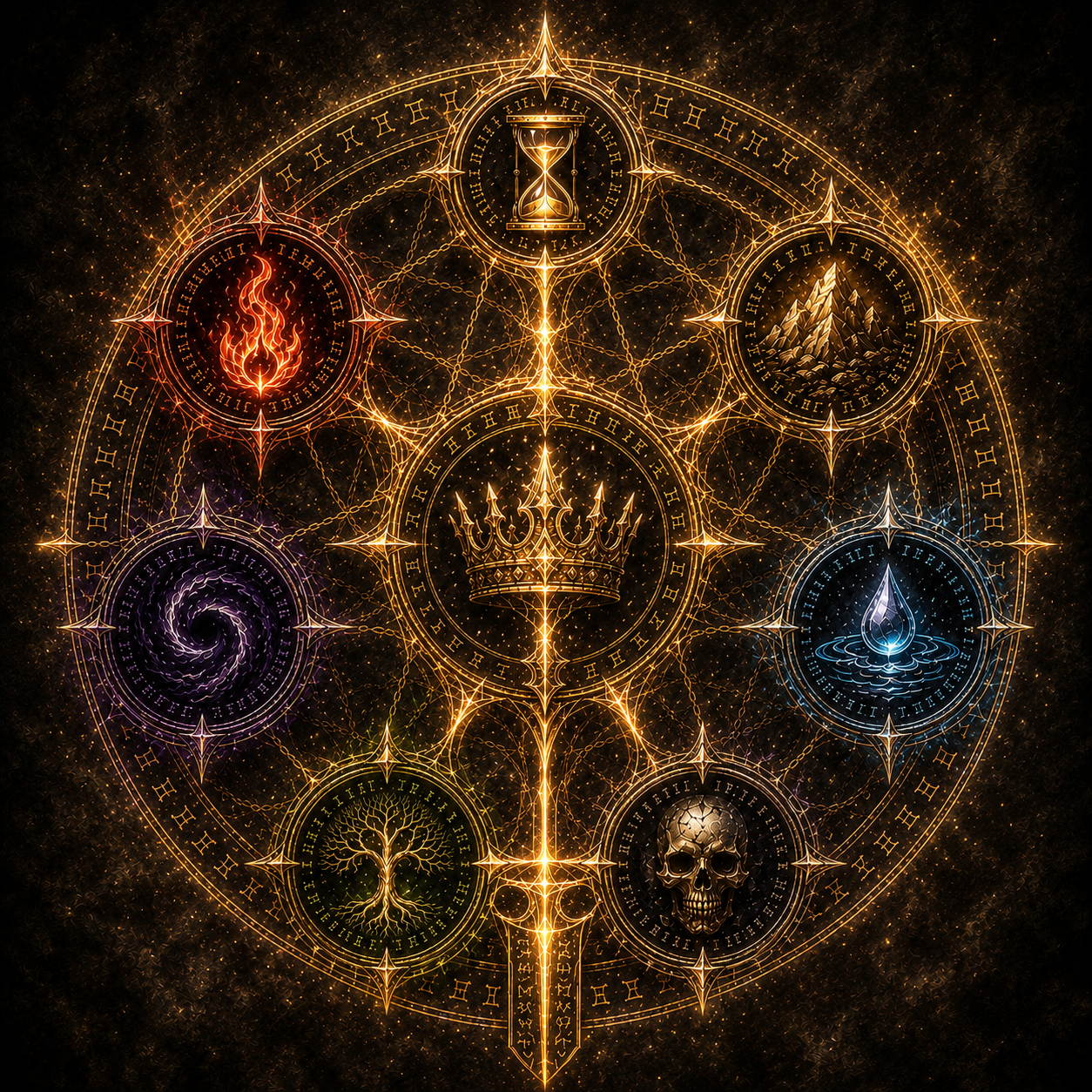
Seven Imperiums rose from Einheart. Each promised to restore the Father’s dominion. Each changed the Old World forever.
Crownfall history · Film I
The First Kaisers
From the Father’s original conquest to the breaking of the Second Empire at Zaharraq, this is the history of the dynasty that taught Einheart to rise from its own ashes.
The Father’s dominion
The First Varian Empire
In the beginning, there was the Father. From His conquest rose the First Varian Empire—a dominion of iron, marble and oath.
It endured for sixty-one years and died with its creator. There was no heir and no successor—only fractured clans and feuding banners. For half a century, city-states and warlords carved the old heartland apart.
The Kaisers rise
The Second Varian Empire
In 112 R.C., Kaiser Hadrian I gathered the clans anew and declared himself the “Heir of the Father.” The phoenix banners flew again, now bearing two heads—East and West—a symbol of unbroken dominion.
Einheart was rebuilt in white stone and iron gates. Power was centralized in the capital while vassal kings and generals governed the provinces. The old clan levies became professional legions sworn to the Father’s heirs rather than tribal lords.
Law became the spine that carried the sword.
The Codex Law hardened the realm through land grants, inheritance, military service and the fatherhood of empire. Its principles would shape every Varian Empire that followed.
Conquest of the Plateau
From 200 to 280 R.C., the Northern Campaigns broke the petty kingdoms above Einheart. The century-long Wars of the Plateau followed—a brutal age of sieges, pacts and betrayals that forged the Einheart Plateau into a single dominion.
By 600 R.C., the Empire reached from the Bay of Kravos to the foothills of the Eshkar Wastes. Trade routes, mines, ports and legions made Einheart the Jewel of the Plateau.
The breaking at Zaharraq
Between 758 and 762 R.C., the Kaisers attempted to seize Zaharraq, fortress-city of Al-Quzzar. The campaign collapsed into attrition and disease. Sultan Jamil II shattered the siege—and with it, the Empire.
Provinces revolted. Generals declared themselves kings. By the end of 762 R.C., the Second Varian Empire had dissolved, yet its Codex and the cult of the Father survived.
The Einheartian Empire
The One-Day Empire
In 763 R.C., the Varian Senate gathered in the Rhinehold, deep in Einheart. Marcus III stepped forward to be crowned and claimed he had found a rune-shard. The chamber erupted. Destiny, they believed, had returned to the Varians.
But the Order of the Shattered Veil had already taken its position. Marcus finished his coronation speech—and never finished his reign. A single silent, precise strike cut through the celebration.
Crowned and slain the same day.
The Third Imperium became the One-Day Empire. Among Varians, its memory survives in a curse: “Not even a day.” It means doomed to fail instantly.
Born in Varethas
The Varethian Imperium
Founded in the Varian province of Varethas, the Fourth Imperium ruled the Old World for three centuries. By 1135 R.C., almost half the continent—from the eastern coasts to the inner seas—marched beneath its banners.
Its armies were unmatched, its discipline absolute and its expansion seemingly inevitable—until it reached the western marshlands.
Invasion forged Vologrod.
Vologrod was not yet a kingdom, but a fractured land of clans, warlords and feuding rulers. From the mud and the ranks rose Alexei: peasant, soldier, commander. They named him Czar.
The war became slow, grinding and unforgiving. Attrition bled both sides. When the Vologrodians withdrew, Field Marshal Erich von Halbrecht believed victory had come and pressed toward Kraveska, the oldest city in the domain.
The silent city
Kraveska offered no banners and no surrender. The Imperium was allowed to march inside. That night, the city burned and the marshes swallowed the army in fire, ambush and annihilation.
Wilhelm Linden II fled west to Einheart. It is said he spoke only once during the retreat: “A year ago, the world marched with us. Now…the world marches against us.”
The Varethian Imperium fell two years later. From its ashes, Vologrod was born.
The Fifth Imperium
The Third Varian Empire
From Varethian ashes rose something harder and far more ruthless. The Kaisers promised to restore the Father’s dominion and erase the shame of Wilhelm Linden’s surrender.
The Volgo frontier
To the south, Vologrod had risen from the same collapse. What the Kaisers called rightful dominion, the Tsars considered inheritance. Between them lay the Volgo River—a frontier of steel and pride that neither realm would relinquish.
Empires the legions could not break
From 1172 to 1260 R.C., Varian legions marched into Lorae’ln. The forests swallowed them and the elves refused to break. From 1260 to 1350, invasion after invasion failed in Kemet’Ra as the sands drank Varian blood.
In the fifteenth century, Imperial fleets tested Azreal and were crushed at sea. The empire’s power on the waves withered.
The last three Kaisers
Arnulf III expanded from 1450 to 1507, but emptied the treasury. Heinrich I ruled from 1507 to 1560, answering revolt with terror. Wilhelm IV, the Final Kaiser, inherited civil war, no clear heir and a state bankrupted by endless campaigns.
By 1607 R.C., provinces stood independent or in open anarchy. The Third Varian Empire joined Varethas in the graveyard of fallen realms.
A shadow of a shadow
The Great Einheartian Empire
Three years after the Fifth Imperium collapsed, General Karl von Sternmark seized Einheart and proclaimed the Great Einheartian Empire. Its High Sovereigns claimed old blood ties to the Varianic dynasties, but their power was bought in gold rather than born from lineage.
City-states bent the knee, guilds abandoned their banners and mercenary legions fought the Unification Wars. Yet the unity was thin. The Sixth Imperium never controlled the whole Plateau.
As long as the gold flowed.
The Tsars held the Volgo. Border wars and succession disputes bled the treasury. The mercenaries continued marching only while they were paid; when the gold ran out, so did their loyalty.
The Sixth endured for 193 years—long enough to matter, too short to be remembered fondly. Among Varians, “Like the Sixth” came to mean half-done, unfinished and lacking strength.
In 1803 R.C., the last High Sovereign fell to revolt. The Imperium ended not with conquest, but with exhaustion.
The Fourth Varian Empire
The Seventh Imperium
For two centuries after the fall of the Sixth, the Einheart Plateau lay fractured into kingdoms, republics and city-states. None called themselves Varian. The glory of the Varians was gone, and the world mocked them for it.
From the opposition benches of the Rhinehold rose Senator Aldon Morvaak. He spoke of unity, vengeance and a Varian people scattered beneath lesser banners. But words were not enough, and the Senate would not kneel.
The Rhinehold burned.
In the winter of 2039 R.C., the opposition never arrived for session. The doors were barred and every rival of Morvaak burned inside. Morvaak denied responsibility, blamed foreign espionage and demanded order. He named himself High Senator—and the next year, Emperor.
War followed. Annexation came under the guise of unity. For a decade, the Plateau bent the knee and the Varian name was restored.
Iron for war. Bone for power.
When the Sangraals descended from the North, the Empire made room for darker power. Kraal knelt before Aldon in Einheart’s great hall, and behind him stood the Inquisitors—silent, patient and unblinking.
Kraal became Inquisitor to Crown Prince Lexen Morvaak: his shadow, advisor and keeper of Sangraal law at court. The Sangraals asked for nothing of faith. Their language was blood, their order was hierarchy and their purpose was the runes.